Who Is Homer What Happen to the Art and Wrighting During the Dorian Age
| Homer | |
|---|---|
 Marble last bust of Homer. Roman copy of a lost Hellenistic original of the 2nd c. BC. | |
| Native proper noun | Ὅμηρος |
| Built-in | c. 8th cent. BC Location unknown[one] |
| Died | Ios, Greece[i] |
| Linguistic communication | Homeric Greek |
| Nationality | Greek |
| Genre | Epic |
| Subject | Epic bicycle |
| Notable works |
|
| Years active | fl. late 8th cent. BC[ane] |
Homer (; Ancient Greek: Ὅμηρος [hómɛːros], Hómēros) was an ancient Greek author and epic poet. He is the reputed writer of the Iliad and the Odyssey, the ii epic poems that are the foundational works of ancient Greek literature. He is regarded as 1 of the greatest and well-nigh influential authors of all time:[2] for case, in Dante Alighieri's Divine Comedy, Virgil refers to him as "Poet sovereign", king of all poets;[3] in the preface to his translation of the Iliad, Alexander Pope acknowledges that Homer has ever been considered the "greatest of poets".[4]
The Iliad is set during the Trojan War, the x-year siege of the city of Troy by a coalition of Mycenaean Greek kingdoms. It focuses on a quarrel between King Agamemnon and the warrior Achilles lasting a few weeks during the final year of the war. The Odyssey focuses on the ten-year journey home of Odysseus, king of Ithaca, after the fall of Troy.
The Homeric epics were the greatest influence on ancient Greek culture and educational activity; to Plato, Homer was simply the one who "has taught Hellenic republic" (τὴν Ἑλλάδα πεπαίδευκεν, tēn Helláda pepaídeuken).[5] [six] From antiquity until the present day, the influence of Homeric epic on Western civilization has been great, inspiring many of its most famous works of literature, music, art and film.[vii]
The question of past whom, when, where and under what circumstances the Iliad and Odyssey were composed continues to be debated. Some scholars consider that the two works were written by different authors.[8] Information technology is generally accepted that the poems were composed at some point around the late eighth or early seventh century BC.[eight] Many accounts of Homer'southward life circulated in classical antiquity, the most widespread being that he was a blind bard from Ionia, a region of fundamental littoral Anatolia in present-day Turkey. Modern scholars consider these accounts legendary.[nine]
The poems are in Homeric Greek, also known equally Ballsy Greek, a literary language which shows a mixture of features of the Ionic and Aeolic dialects from unlike centuries; the predominant influence is Eastern Ionic.[ten] [11] Most researchers believe that the poems were originally transmitted orally.[12]
Works attributed to Homer [edit]
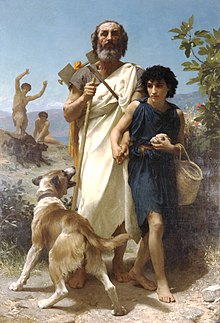
Today only the Iliad and the Odyssey are associated with the name 'Homer'. In antiquity, a very big number of other works were sometimes attributed to him, including the Homeric Hymns, the Contest of Homer and Hesiod, the Little Iliad, the Nostoi, the Thebaid, the Cypria, the Epigoni, the comic mini-epic Batrachomyomachia ("The Frog-Mouse War"), the Margites, the Capture of Oechalia, and the Phocais. These claims are not considered accurate today and were past no means universally accepted in the ancient world. As with the multitude of legends surrounding Homer's life, they indicate piddling more the centrality of Homer to ancient Greek culture.[xiii] [14] [15]
Ancient biographical traditions [edit]
Some ancient claims near Homer were established early on and repeated oft. They include that Homer was blind (taking as self-referential a passage describing the bullheaded bard Demodocus[16] [17]), that he was born in Chios, that he was the son of the river Meles and the nymph Critheïs, that he was a wandering bard, that he composed a varying list of other works (the "Homerica"), that he died either in Ios or after failing to solve a riddle ready by fishermen, and diverse explanations for the proper noun "Homer" (Ὅμηρος : Hómēros).
The two best known ancient biographies of Homer are the Life of Homer by the Pseudo-Herodotus and the Contest of Homer and Hesiod.[1] [xviii]
In the early quaternary century BC Alcidamas composed a fictional account of a verse contest at Chalcis with both Homer and Hesiod. Homer was expected to win, and answered all of Hesiod's questions and puzzles with ease. And so, each of the poets was invited to recite the best passage from their work. Hesiod selected the beginning of Works and Days: "When the Pleiades born of Atlas ... all in due season". Homer chose a description of Greek warriors in germination, facing the foe, taken from the Iliad. Though the crowd acclaimed Homer victor, the judge awarded Hesiod the prize; the poet who praised husbandry, he said, was greater than the one who told tales of battles and slaughter.[19]
History of Homeric scholarship [edit]
Ancient [edit]

Part of an eleventh-century manuscript, "the Townley Homer". The writings on the top and right side are scholia.
The study of Homer is 1 of the oldest topics in scholarship, dating back to antiquity.[twenty] [21] [22] Nonetheless, the aims of Homeric studies have changed over the course of the millennia.[twenty] The earliest preserved comments on Homer concern his treatment of the gods, which hostile critics such as the poet Xenophanes of Colophon denounced as immoral.[22] The allegorist Theagenes of Rhegium is said to have dedicated Homer by arguing that the Homeric poems are allegories.[22] The Iliad and the Odyssey were widely used as school texts in ancient Greek and Hellenistic cultures.[xx] [22] [23] They were the first literary works taught to all students.[23] The Iliad, particularly its first few books, was far more intently studied than the Odyssey during the Hellenistic and Roman periods.[23]
As a outcome of the poems' prominence in classical Greek education, extensive commentaries on them adult to explain parts of the poems that were culturally or linguistically difficult.[twenty] [22] During the Hellenistic and Roman periods, many interpreters, especially the Stoics, who believed that Homeric poems conveyed Stoic doctrines, regarded them as allegories, containing subconscious wisdom.[22] Perhaps partially considering of the Homeric poems' all-encompassing use in education, many authors believed that Homer'southward original purpose had been to educate.[22] Homer's wisdom became so widely praised that he began to larn the image of almost a prototypical philosopher.[22] Byzantine scholars such as Eustathius of Thessalonica and John Tzetzes produced commentaries, extensions and scholia to Homer, peculiarly in the twelfth century.[24] [22] Eustathius's commentary on the Iliad alone is massive, sprawling over well-nigh iv,000 oversized pages in a twenty-commencement century printed version and his commentary on the Odyssey an additional near ii,000.[22]
Modern [edit]

In 1488, the Greek scholar Demetrios Chalkokondyles published the editio princeps of the Homeric poems.[22] The earliest modern Homeric scholars started with the same bones approaches towards the Homeric poems as scholars in antiquity.[22] [21] [20] The allegorical interpretation of the Homeric poems that had been and so prevalent in antiquity returned to become the prevailing view of the Renaissance.[22] Renaissance humanists praised Homer as the archetypically wise poet, whose writings contain hidden wisdom, bearded through allegory.[22] In western Europe during the Renaissance, Virgil was more widely read than Homer and Homer was often seen through a Virgilian lens.[25]
In 1664, contradicting the widespread praise of Homer as the epitome of wisdom, François Hédelin, abbé d'Aubignac wrote a scathing assault on the Homeric poems, declaring that they were breathless, immoral, tasteless, and without style, that Homer never existed, and that the poems were hastily cobbled together past incompetent editors from unrelated oral songs.[21] Fifty years later, the English language scholar Richard Bentley ended that Homer did exist, but that he was an obscure, prehistoric oral poet whose compositions bear little relation to the Iliad and the Odyssey every bit they have been passed down.[21] According to Bentley, Homer "wrote a Sequel of Songs and Rhapsodies, to be sung by himself for small-scale Earnings and expert Cheer at Festivals and other Days of Merriment; the Ilias he wrote for men, and the Odysseis for the other Sexual activity. These loose songs were not collected together in the Form of an epic Poem till Pisistratus' time, about 500 Years afterward."[21]
Friedrich August Wolf'south Prolegomena ad Homerum, published in 1795, argued that much of the material later incorporated into the Iliad and the Odyssey was originally composed in the tenth century BC in the course of brusque, carve up oral songs,[26] [27] [21] which passed through oral tradition for roughly four hundred years before existence assembled into prototypical versions of the Iliad and the Odyssey in the sixth century BC by literate authors.[26] [27] [21] After being written down, Wolf maintained that the 2 poems were extensively edited, modernized, and eventually shaped into their present state every bit creative unities.[26] [27] [21] Wolf and the "Analyst" school, which led the field in the nineteenth century, sought to recover the original, authentic poems which were thought to be curtained by later excrescences.[26] [27] [21] [28]
Within the Analyst school were ii camps: proponents of the "lay theory", which held that the Iliad and the Odyssey were put together from a large number of short, independent songs,[21] and proponents of the "nucleus theory", which held that Homer had originally composed shorter versions of the Iliad and the Odyssey, which later poets expanded and revised.[21] A small grouping of scholars opposed to the Analysts, dubbed "Unitarians", saw the after additions as superior, the piece of work of a unmarried inspired poet.[26] [27] [21] By around 1830, the key preoccupations of Homeric scholars, dealing with whether or not "Homer" actually existed, when and how the Homeric poems originated, how they were transmitted, when and how they were finally written downwardly, and their overall unity, had been dubbed "the Homeric Question".[21]
Following Earth State of war I, the Analyst school began to fall out of favor among Homeric scholars.[21] It did not dice out entirely, only it came to be increasingly seen every bit a discredited expressionless end.[21] Starting in effectually 1928, Milman Parry and Albert Lord, subsequently their studies of folk bards in the Balkans, adult the "Oral-Formulaic Theory" that the Homeric poems were originally composed through improvised oral performances, which relied on traditional epithets and poetic formulas.[29] [28] [21] This theory found very wide scholarly credence[29] [28] [21] and explained many previously puzzling features of the Homeric poems, including their unusually archaic language, their extensive use of stock epithets, and their other "repetitive" features.[28] Many scholars concluded that the "Homeric question" had finally been answered.[21]
Meanwhile, the 'Neoanalysts' sought to bridge the gap between the 'Analysts' and 'Unitarians'.[xxx] [31] The Neoanalysts sought to trace the relationships betwixt the Homeric poems and other epic poems, which have now been lost, but of which mod scholars exercise possess some patchy knowledge.[21] Neoanalysts concur that knowledge of before versions of the epics can be derived from anomalies of construction and detail in the surviving versions of the Iliad and Odyssey. These anomalies indicate to earlier versions of the Iliad in which Ajax played a more prominent function, in which the Achaean diplomatic mission to Achilles comprised different characters, and in which Patroclus was actually mistaken for Achilles by the Trojans. They point to earlier versions of the Odyssey in which Telemachus went in search of news of his father not to Menelaus in Sparta simply to Idomeneus in Crete, in which Telemachus met up with his begetter in Crete and conspired with him to render to Ithaca disguised as the soothsayer Theoclymenus, and in which Penelope recognized Odysseus much before in the narrative and conspired with him in the destruction of the suitors.[32]
Contemporary [edit]
Almost contemporary scholars, although they disagree on other questions nearly the genesis of the poems, concur that the Iliad and the Odyssey were not produced past the same author, based on "the many differences of narrative style, theology, ethics, vocabulary, and geographical perspective, and by the apparently imitative character of certain passages of the Odyssey in relation to the Iliad."[33] [34] [35] [21] Nearly all scholars agree that the Iliad and the Odyssey are unified poems, in that each poem shows a articulate overall design, and that they are not only strung together from unrelated songs.[21] It is also generally agreed that each verse form was composed by and large past a single author, who probably relied heavily on older oral traditions.[21] Well-nigh all scholars agree that the Doloneia in Book X of the Iliad is not part of the original poem, but rather a later on insertion by a different poet.[21]
Some ancient scholars believed Homer to take been an eyewitness to the Trojan War; others idea he had lived upwards to 500 years afterwards.[36] Gimmicky scholars proceed to contend the date of the poems.[37] [38] [21] A long history of oral manual lies behind the limerick of the poems, complicating the search for a precise date.[39] At one extreme, Richard Janko has proposed a engagement for both poems to the eighth century BC based on linguistic analysis and statistics.[37] [38] Barry B. Powell dates the limerick of the Iliad and the Odyssey to one-time between 800 and 750 BC, based on the argument from Herodotus, who lived in the late 5th century BC, that Homer lived four hundred years before his own time "and non more than" (καὶ οὐ πλέοσι), and on the fact that the poems do non mention hoplite boxing tactics, inhumation, or literacy.[40]
Martin Litchfield West has argued that the Iliad echoes the verse of Hesiod, and that it must have been composed effectually 660–650 BC at the earliest, with the Odyssey upwards to a generation afterward.[41] [42] [21] He also interprets passages in the Iliad as showing noesis of historical events that occurred in the ancient Near East during the centre of the seventh century BC, including the destruction of Babylon by Sennacherib in 689 BC and the Sack of Thebes by Ashurbanipal in 663/4 BC.[21] At the other extreme, a few American scholars such as Gregory Nagy encounter "Homer" as a continually evolving tradition, which grew much more than stable as the tradition progressed, but which did not fully end to continue irresolute and evolving until as late as the center of the second century BC.[37] [38] [21]
"'Homer" is a name of unknown etymological origin, effectually which many theories were erected in artifact. 1 such linkage was to the Greek ὅμηρος (hómēros), "hostage" (or "surety"). The explanations suggested by modernistic scholars tend to mirror their position on the overall Homeric question. Nagy interprets it as "he who fits (the song) together". West has advanced both possible Greek and Phoenician etymologies.[43] [44]
Historicity of the Homeric epics and Homeric lodge [edit]

Greece according to the Iliad
Scholars continue to debate questions such as whether the Trojan War actually took identify – and if and so when and where – and to what extent the society depicted by Homer is based on his own or one which was, fifty-fifty at the time of the poems' composition, known simply as legends. The Homeric epics are largely set in the east and center of the Mediterranean, with some scattered references to Egypt, Ethiopia and other afar lands, in a warlike order that resembles that of the Greek world slightly before the hypothesized date of the poems' composition.[45] [46] [47] [48]
In ancient Greek chronology, the sack of Troy was dated to 1184 BC. By the nineteenth century, in that location was widespread scholarly skepticism that the Trojan State of war had always happened and that Troy had even existed, only in 1873 Heinrich Schliemann announced to the world that he had discovered the ruins of Homer's Troy at Hissarlik in mod Turkey. Some gimmicky scholars think the destruction of Troy VIIa c. 1220 BC was the origin of the myth of the Trojan War, others that the poem was inspired past multiple similar sieges that took place over the centuries.[49]
Most scholars at present concord that the Homeric poems depict community and elements of the material world that are derived from different periods of Greek history.[28] [l] [51] For case, the heroes in the poems utilize bronze weapons, characteristic of the Bronze Age in which the poems are set, rather than the later Atomic number 26 Age during which they were equanimous;[28] [l] [51] even so the same heroes are cremated (an Fe Age practice) rather than buried (every bit they were in the Statuary Age).[28] [50] [51] In some parts of the Homeric poems, heroes are described as carrying big shields like those used by warriors during the Mycenaean period,[28] but, in other places, they are instead described carrying the smaller shields that were commonly used during the fourth dimension when the poems were written in the early Iron Historic period.[28] In the Iliad ten.260–265, Odysseus is described as wearing a helmet made of boar'southward tusks. Such helmets were not worn in Homer'southward time, merely were normally worn by aristocratic warriors between 1600 and 1150 BC.[52] [53] [54]
The decipherment of Linear B in the 1950s by Michael Ventris and continued archaeological investigation has increased modern scholars' agreement of Aegean civilisation, which in many ways resembles the ancient Near Eastward more than the society described by Homer.[55] Some aspects of the Homeric world are simply made up;[28] for instance, the Iliad 22.145–56 describes there being two springs that run well-nigh the city of Troy, ane that runs steaming hot and the other that runs icy cold.[28] It is hither that Hector takes his terminal stand up against Achilles.[28] Archaeologists, however, accept uncovered no show that springs of this description ever actually existed.[28]
Style and language [edit]
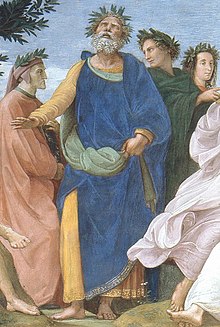
The Homeric epics are written in an artificial literary linguistic communication or 'Kunstsprache' simply used in epic hexameter poetry. Homeric Greek shows features of multiple regional Greek dialects and periods, just is fundamentally based on Ionic Greek, in keeping with the tradition that Homer was from Ionia. Linguistic assay suggests that the Iliad was equanimous slightly before the Odyssey, and that Homeric formulae preserve older features than other parts of the poems.[56] [57]
The poems were equanimous in unrhymed dactylic hexameter; aboriginal Greek metre was quantity-based rather than stress-based.[58] [59] Homer often uses set phrases such as epithets ('crafty Odysseus', 'rosy-fingered Dawn', 'owl-eyed Athena', etc.), Homeric formulae ('and then answered [him/her], Agamemnon, king of men', 'when the early on-born rose-fingered Dawn came to low-cal', 'thus he/she spoke'), simile, type scenes, band composition and repetition. These habits help the extemporizing bard, and are characteristic of oral poetry. For example, the master words of a Homeric sentence are generally placed towards the kickoff, whereas literate poets like Virgil or Milton use longer and more complicated syntactical structures. Homer then expands on these ideas in subsequent clauses; this technique is chosen parataxis.[60]
The so-called 'type scenes' (typische Szenen), were named by Walter Arend in 1933. He noted that Homer often, when describing frequently recurring activities such as eating, praying, fighting and dressing, used blocks of set phrases in sequence that were then elaborated by the poet. The 'Analyst' school had considered these repetitions as un-Homeric, whereas Arend interpreted them philosophically. Parry and Lord noted that these conventions are found in many other cultures.[61] [62]
'Band limerick' or chiastic structure (when a phrase or idea is repeated at both the start and end of a story, or a series of such ideas first appears in the order A, B, C ... before being reversed equally ... C, B, A) has been observed in the Homeric epics. Opinion differs as to whether these occurrences are a conscious artistic device, a mnemonic aid or a spontaneous feature of human storytelling.[63] [64]
Both of the Homeric poems begin with an invocation to the Muse.[65] In the Iliad, the poet beseeches her to sing of "the anger of Achilles",[65] and, in the Odyssey, he asks her to tell of "the man of many means".[65] A similar opening was later employed by Virgil in his Aeneid.[65]
Textual transmission [edit]

The orally transmitted Homeric poems were put into written form at some bespeak betwixt the 8th and 6th centuries BC. Some scholars believe that they were dictated to a scribe by the poet and that our inherited versions of the Iliad and Odyssey were in origin orally-dictated texts.[66] Albert Lord noted that the Balkan bards that he was studying revised and expanded their songs in their process of dictating.[67] Some scholars hypothesize that a similar process of revision and expansion occurred when the Homeric poems were first written downwardly.[68] [69]
Other scholars concur that, after the poems were created in the 8th century, they connected to exist orally transmitted with considerable revision until they were written down in the 6th century.[seventy] Later textualisation, the poems were each divided into 24 rhapsodes, today referred to every bit books, and labelled past the letters of the Greek alphabet. Almost scholars attribute the book divisions to the Hellenistic scholars of Alexandria, in Egypt.[71] Some trace the divisions back further to the Classical menstruation.[72] Very few credit Homer himself with the divisions.[73]
In artifact, it was widely held that the Homeric poems were collected and organised in Athens in the tardily 6th century BC past the tyrant Peisistratos (died 528/seven BC), in what subsequent scholars accept dubbed the "Peisistratean recension".[74] [22] The thought that the Homeric poems were originally transmitted orally and first written down during the reign of Peisistratos is referenced by the first-century BC Roman orator Cicero and is also referenced in a number of other surviving sources, including ii ancient Lives of Homer.[22] From around 150 BC, the texts of the Homeric poems seem to have become relatively established. After the establishment of the Library of Alexandria, Homeric scholars such as Zenodotus of Ephesus, Aristophanes of Byzantium and in particular Aristarchus of Samothrace helped found a canonical text.[75]
The start printed edition of Homer was produced in 1488 in Milan, Italian republic. Today scholars use medieval manuscripts, papyri and other sources; some argue for a "multi-text" view, rather than seeking a single definitive text. The nineteenth-century edition of Arthur Ludwich mainly follows Aristarchus'south work, whereas van Thiel'south (1991, 1996) follows the medieval vulgate. Others, such equally Martin West (1998–2000) or T.W. Allen, fall somewhere between these two extremes.[75]
See also [edit]
- Achaeans (Homer)
- Aeneid
- Bibliomancy
- Catalogue of Ships
- Creophylus of Samos
- Circadian Poets
- Deception of Zeus
- Epithets in Homer
- Geography of the Odyssey
- Greek mythology
- Hector
- Historicity of Homer
- Homeric psychology
- Homeric scholarship
- Ithaca
- List of Homeric characters
- Peisistratos
- Sortes Homericae
- Tabula iliaca
- Telemachy
- The Golden Bough
- Trojan Boxing Order
- Trojan War in literature and the arts
- Venetus A Manuscript
Notes [edit]
- ^ a b c d Lefkowitz, Mary R. (2013). The Lives of the Greek Poets. A&C Black. pp. xiv–30. ISBN978-1472503077.
- ^ "Acquire about Homer's The Iliad and The Odyssey". Encyclopaedia Britannica . Retrieved 31 August 2021.
- ^ Divine Comedy, Inferno, Canto IV, 86-88 (Longfellow's translation):
"Him with that falchion in his manus behold,
Who comes before the three, even as their lord.
That one is Homer, Poet sovereign;" - ^ Alexander Pope'south Preface to his translation of the Iliad:
"Homer is universally allowed to have had the greatest invention of any writer any. The praise of judgment Virgil has justly contested with him, and others may accept their pretensions equally to item excellencies; but his invention remains all the same unrivalled. Nor is information technology a wonder if he has always been best-selling the greatest of poets, who well-nigh excelled in that which is the very foundation of poetry." - ^ Too, Yun Lee (2010). The Idea of the Library in the Ancient World. OUP Oxford. p. 86. ISBN978-0199577804 . Retrieved 22 November 2016.
- ^ MacDonald, Dennis R. (1994). Christianizing Homer: The Odyssey, Plato, and the Acts of Andrew. Oxford University Press. p. 17. ISBN978-0195358629. Archived from the original on xxx June 2017. Retrieved 22 November 2016.
- ^ Latacz, Joachim (1996). Homer, His Art and His World. Academy of Michigan Press. ISBN978-0472083534 . Retrieved 22 November 2016.
- ^ a b Croally, Neil; Hyde, Roy (2011). Classical Literature: An Introduction. Routledge. p. 26. ISBN978-1136736629 . Retrieved 23 Nov 2016.
- ^
- Wilson, Nigel (2013). Encyclopedia of Ancient Hellenic republic. Routledge. p. 366. ISBN978-1136788000 . Retrieved 22 November 2016.
- Romilly, Jacqueline de (1985). A Brusque History of Greek Literature. University of Chicago Printing. p. 1. ISBN978-0226143125 . Retrieved 22 Nov 2016.
- Graziosi, Barbara (2002). Inventing Homer: The Early Reception of Epic. Cambridge University Press. p. 15. ISBN978-0521809665 . Retrieved 22 November 2016.
- ^ Hose, Martin; Schenker, David (2015). A Companion to Greek Literature. John Wiley & Sons. p. 445. ISBN978-1118885956.
- ^ Miller, D. Gary (2013). Ancient Greek Dialects and Early on Authors: Introduction to the Dialect Mixture in Homer, with Notes on Lyric and Herodotus. Walter de Gruyter. p. 351. ISBN978-1614512950 . Retrieved 23 Nov 2016.
- ^ Ahl, Frederick; Roisman, Hanna (1996). The Odyssey Re-formed. Cornell University Press. ISBN978-0801483356 . Retrieved 23 November 2016.
- ^ Kelly, Adrian D. (2012). "Homerica". The Homer Encyclopedia. doi:10.1002/9781444350302.wbhe0606. ISBN978-1405177689.
- ^ Graziosi, Barbara; Haubold, Johannes (2005). Homer: The Resonance of Epic. A&C Black. pp. 24–26. ISBN978-0715632826.
- ^ Graziosi, Barbara (2002). Inventing Homer: The Early Reception of Ballsy. Cambridge Academy Press. pp. 165–168. ISBN978-0521809665.
- ^ Graziosi, Barbara (2002). Inventing Homer: The Early Reception of Epic. Cambridge University Press. p. 138. ISBN978-0521809665.
- ^ Odyssey, 8:64ff.
- ^ Kelly, Adrian D. (2012). "Biographies of Homer". The Homer Encyclopedia. doi:x.1002/9781444350302.wbhe0243. ISBN978-1405177689.
- ^ West, 1000. L. Theogony & Works and Days. Oxford University Press. p. 20.
- ^ a b c d eastward Dickey, Eleanor (2012). "Scholarship, Ancient". The Homer Encyclopedia. doi:10.1002/9781444350302.wbhe1307. ISBN978-1405177689.
- ^ a b c d e f g h i j k fifty k n o p q r due south t u v w x y z aa West, M. L. (December 2011). "The Homeric Question Today". Proceedings of the American Philosophical Order. 155 (four): 383–393. JSTOR 23208780.
- ^ a b c d e f g h i j m l m north o p Lamberton, Robert (2010). "Homer". In Grafton, Anthony; Nearly, Glenn W.; Settis, Salvatore (eds.). The Classical Tradition. Cambridge, Massachusetts and London, England: The Belknap Press of Harvard University Printing. pp. 449–452. ISBN978-0-674-03572-0.
- ^ a b c Hunter, Richard 50. (2018). The Measure of Homer: The Ancient Reception of the Iliad and the Odyssey . Cambridge, England: Cambridge University Printing. pp. 4–7. ISBN978-1-108-42831-6.
- ^ Kaldellis, Anthony (2012). "Scholarship, Byzantine". The Homer Encyclopedia. doi:10.1002/9781444350302.wbhe1308. ISBN978-1405177689.
- ^ Heiden, Bruce (2012). "Scholarship, Renaissance through 17th Century". The Homer Encyclopedia. doi:10.1002/9781444350302.wbhe1310. ISBN978-1405177689.
- ^ a b c d due east Heiden, Bruce (2012). "Scholarship, 18th Century". The Homer Encyclopedia. doi:x.1002/9781444350302.wbhe1311. ISBN978-1405177689.
- ^ a b c d e Heiden, Bruce (2012). "Scholarship, 19th Century". The Homer Encyclopedia. doi:10.1002/9781444350302.wbhe1312. ISBN978-1405177689.
- ^ a b c d e f g h i j k l chiliad Taplin, Oliver (1986). "two: Homer". In Boardman, John; Griffin, Jasper; Murray, Oswyn (eds.). The Oxford History of the Classical World. Oxford, England: Oxford University Press. pp. 50–77. ISBN978-0198721123.
- ^ a b Foley, John Miles (1988). The Theory of Oral Limerick: History and Methodology. Indiana University Printing. ISBN978-0253342607.
- ^ Heiden, Bruce (2012). "Scholarship, 20th Century". The Homer Encyclopedia. doi:ten.1002/9781444350302.wbhe1313. ISBN978-1405177689.
- ^ Edwards, Marker W. (2012). "Neoanalysis". The Homer Encyclopedia. doi:ten.1002/9781444350302.wbhe0968. ISBN978-1405177689.
- ^ Reece, Steve. "The Cretan Odyssey: A Lie Truer than Truth". American Periodical of Philology 115 (1994) 157-173. The_Cretan_Odyssey
- ^ West, M. L. (1999). "The Invention of Homer". Classical Quarterly. 49 (two): 364–382. doi:10.1093/cq/49.ii.364. JSTOR 639863.
- ^ Westward, Martin L. (2012). "Homeric Question". The Homer Encyclopedia. doi:10.1002/9781444350302.wbhe0605. ISBN978-1405177689.
- ^ Latacz, Joachim; Bierl, Anton; Olson, Southward. Douglas (2015). "New Trends in Homeric Scholarship" in Homer'southward Iliad: The Basel Commentary. De Gruyter. ISBN978-1614517375.
- ^ Saïd, Suzanne (2011). Homer and the Odyssey. OUP Oxford. pp. 14–17. ISBN978-0199542840.
- ^ a b c Graziosi, Barbara (2002). Inventing Homer: The Early Reception of Ballsy. Cambridge Academy Press. pp. 90–92. ISBN978-0521809665.
- ^ a b c Fowler, Robert; Fowler, Robert Louis (2004). The Cambridge Companion to Homer. Cambridge University Printing. pp. 220–232. ISBN978-0521012461.
- ^ Burgess, Jonathan South. (2003). The Tradition of the Trojan State of war in Homer and the Ballsy Cycle. JHU Press. pp. 49–53. ISBN978-0801874819.
- ^ Barry, Barry B. (1996). Homer and the Origins of the Greek Alphabet. Cambridge, England: Cambridge University Press. pp. 217–222. ISBN978-0-521-58907-ix.
- ^ Hall, Jonathan M. (2002). Hellenicity: Between Ethnicity and Culture. University of Chicago Press. pp. 235–236. ISBN978-0226313290.
- ^ West, Martin 50. (2012). "Date of Homer". The Homer Encyclopedia. doi:10.1002/9781444350302.wbhe0330. ISBN978-1405177689.
- ^ Graziosi, Barbara (2002). Inventing Homer: The Early Reception of Epic. Cambridge University Press. pp. 51–89. ISBN978-0521809665.
- ^ West, One thousand. Fifty. (1997). The Eastward Face up of Helicon: West Asiatic Elements in Greek Poetry and Myth. Oxford: Clarendon Press. p. 622.
- ^ Raaflaub, Kurt A. (2012). "Historicity of Homer". The Homer Encyclopedia. doi:ten.1002/9781444350302.wbhe0601. ISBN978-1405177689.
- ^ Finley, Moses I. (1991). The Globe of Odysseus. Penguin. ISBN978-0140136869.
- ^ Wees, Hans van (2009). War and Violence in Aboriginal Greece. ISD LLC. ISBN978-1910589298.
- ^ Morris, Ian (1986). "The Use and Abuse of Homer". Classical Antiquity. 5 (1): 81–138. doi:10.2307/25010840. JSTOR 25010840.
- ^ Dowden, Ken; Livingstone, Niall (2011). A Companion to Greek Mythology. John Wiley & Sons. p. 440. ISBN978-1444396935.
- ^ a b c Sacks, David; Murray, Oswyn; Brody, Lisa R. (2014). Encyclopedia of the Aboriginal Greek Earth. Infobase Publishing. p. 356. ISBN978-1438110202.
- ^ a b c Morris, Ian; Powell, Barry B. (1997). A New Companion to Homer. BRILL. pp. 434–435. ISBN978-9004217607.
- ^ Wood, Michael (1996). In Search of the Trojan War. Berkeley, California: University of California Press. p. 130. ISBN978-0-520-21599-three . Retrieved 1 September 2017.
- ^ Schofield, Louise (2007). The Mycenaeans. Los Angeles, California: The J. Paul Getty Museum. p. 119. ISBN978-0-89236-867-9 . Retrieved 1 September 2017.
- ^ Everson, Tim (2004). Warfare in Ancient Greece: Artillery and Armour from the Heroes of Homer to Alexander the Neat. Brimscombe Port: The History Press. pp. 9–10. ISBN978-0-7524-9506-four . Retrieved 1 September 2017.
- ^ Morris, Ian; Powell, Barry B. (1997). A New Companion to Homer. BRILL. p. 625. ISBN978-9004217607.
- ^ Willi, Andreas (2012). "Language, Homeric". The Homer Encyclopedia. doi:ten.1002/9781444350302.wbhe0792. ISBN978-1405177689.
- ^ Bakker, Egbert J. (2010). A Companion to the Ancient Greek Linguistic communication. John Wiley & Sons. p. 401. ISBN978-1444317404.
- ^ Westward. Edwards, Mark (2012). "Meter". The Homer Encyclopedia. doi:x.1002/9781444350302.wbhe0913. ISBN978-1405177689.
- ^ Nussbaum, G.B. (1986). Homer's Metre: A Practical Guide for Reading Greek Hexameter Verse. Bristol Classical Press. ISBN978-0862921729.
- ^ Edwards, Mark Westward. (2012). "Style". The Homer Encyclopedia. doi:10.1002/9781444350302.wbhe1377. ISBN978-1405177689.
- ^ Reece, Steve T. (2012). "Type-Scenes". The Homer Encyclopedia. doi:10.1002/9781444350302.wbhe1488. ISBN978-1405177689.
- ^ Edwards, MW (1992). "Homer and Oral Tradition: The Type-Scene". Oral Tradition. 7: 284–330.
- ^ Stanley, Keith (2014). The Shield of Homer: Narrative Structure in the Illiad. Princeton University Press. ISBN978-1400863372.
- ^ Minchin, Elizabeth (2012). "Band Composition". The Homer Encyclopedia. doi:ten.1002/9781444350302.wbhe1287. ISBN978-1405177689.
- ^ a b c d Adler, Eve (2003). Vergil's Empire: Political Thought in the Aeneid. Lanham, Maryland: Rowman & Littlefield Publishers, Inc. p. 4. ISBN978-0-7425-2167-4.
- ^ Steve Reece, "Homer's Iliad and Odyssey: From Oral Performance to Written Text", in Marking Amodio (ed.), New Directions in Oral Theory (Tempe: Heart for Medieval and Renaissance Studies, 2005) 43-89.
- ^ Albert B. Lord, The Vocaliser of Tales (Cambridge, MA: Harvard Academy Press, 1960).
- ^ Kirk, M.S. (1976). Homer and the Oral Tradition. Cambridge University Press. p. 117. ISBN978-0521213097.
- ^ Foley, John Miles (2012). "Oral Dictated Texts". The Homer Encyclopedia. doi:10.1002/9781444350302.wbhe1029. ISBN978-1405177689.
- ^ Nagy, Gregory (1996). Poetry equally Functioning: Homer and Across. Cambridge Academy Press. ISBN978-0521558488.
- ^ U. von Wilamowitz-Moellendorff, Homerische Untersuchungen (Berlin, 1884) 369; R. Pfeiffer, History of Classical Scholarship (Oxford, 1968) 116-117.
- ^ West, Martin L. (2012). "Book Partition". The Homer Encyclopedia. doi:10.1002/9781444350302.wbhe0253. ISBN978-1405177689. ; S. West, The Ptolemaic Papyri of Homer (Cologne, 1967) 18-25.
- ^ P. Mazon, Introduction à l'Iliade (Paris, 1912) 137-forty; C.H. Whitman, Homer and the Heroic Tradition (Cambridge [Mass.], 1958) 282-83; G.P. Goold, "Homer and the Alphabet", TAPA 96 (1960) 272-91; K. Stanley, The Shield of Homer (Princeton, 1993) 37, 249ff.
- ^ Jensen, Minna Skafte (1980). The Homeric Question and the Oral-formulaic Theory. Museum Tusculanum Press. p. 128. ISBN978-8772890968.
- ^ a b Haslam, Michael (2012). "Text and Transmission". The Homer Encyclopedia. doi:10.1002/9781444350302.wbhe1413. ISBN978-1405177689.
Selected bibliography [edit]
Editions [edit]
- Texts in Homeric Greek
- Demetrius Chalcondyles editio princeps, Florence, 1488
- the Aldine editions (1504 and 1517)
- 1st ed. with comments, Micyllus and Camerarius, Basel, 1535, 1541 (improved text), 1551 (incl. the Batrachomyomachia)
- Th. Ridel, Strasbourg, c. 1572, 1588 and 1592.
- Wolf (Halle, 1794–1795; Leipzig, 1804 1807)
- Spitzner (Gotha, 1832–1836)
- Bekker (Berlin, 1843; Bonn, 1858)
- La Roche (Odyssey, 1867–1868; Iliad, 1873–1876, both at Leipzig)
- Ludwich (Odyssey, Leipzig, 1889–1891; Iliad, 2 vols., 1901 and 1907)
- Westward. Leaf (Iliad, London, 1886–1888; 2nd ed. 1900–1902)
- William Walter Merry and James Riddell (Odyssey i–xii., 2nd ed., Oxford, 1886)
- Monro (Odyssey xiii–xxiv. with appendices, Oxford, 1901)
- Monro and Allen (Iliad), and Allen (Odyssey, 1908, Oxford).
- D.B. Monro and T.Westward. Allen 1917–1920, Homeri Opera (5 volumes: Iliad=3rd edition, Odyssey=second edition), Oxford. ISBN 0-19-814528-4, ISBN 0-19-814529-2, ISBN 0-xix-814531-4, ISBN 0-xix-814532-two, ISBN 0-19-814534-9
- H. van Thiel 1991, Homeri Odyssea, Hildesheim. ISBN 3-487-09458-four, 1996, Homeri Ilias, Hildesheim. ISBN 3-487-09459-2
- Thou. L. West 1998–2000, Homeri Ilias (ii volumes), Munich/Leipzig. ISBN iii-598-71431-nine, ISBN 3-598-71435-1
- P. von der Mühll 1993, Homeri Odyssea, Munich/Leipzig. ISBN 3-598-71432-seven
- Thousand. L. Westward 2017, Homerus Odyssea, Berlin/Boston. ISBN iii-11-042539-4
Interlinear translations [edit]
- The Iliad of Homer a Parsed Interlinear, Handheldclassics.com (2008) Text ISBN 978-1-60725-298-half-dozen
English translations [edit]
This is a fractional list of translations into English language of Homer's Iliad and Odyssey.
- Augustus Taber Murray (1866–1940)
- Homer: Iliad, 2 vols., revised by William F. Wyatt, Loeb Classical Library, Harvard University Press (1999).
- Homer: Odyssey, 2 vols., revised past George Due east. Dimock, Loeb Classical Library, Harvard University Press (1995).
- Robert Fitzgerald (1910–1985)
- The Iliad, Farrar, Straus and Giroux (2004) ISBN 0-374-52905-one
- The Odyssey, Farrar, Straus and Giroux (1998) ISBN 0-374-52574-9
- Robert Fagles (1933–2008)
- The Iliad, Penguin Classics (1998) ISBN 0-14-027536-3
- The Odyssey, Penguin Classics (1999) ISBN 0-14-026886-3
- Stanley Lombardo (b. 1943)
- Iliad, Hackett Publishing Company (1997) ISBN 0-87220-352-ii
- Odyssey, Hackett Publishing Company (2000) ISBN 0-87220-484-7
- Iliad, (Audiobook) Parmenides (2006) ISBN 1-930972-08-3
- Odyssey, (Audiobook) Parmenides (2006) ISBN 1-930972-06-vii
- The Essential Homer, (Audiobook) Parmenides (2006) ISBN 1-930972-12-1
- The Essential Iliad, (Audiobook) Parmenides (2006) ISBN 1-930972-10-five
- Barry B. Powell (b. 1942)
- "Iliad", Oxford University Press (2013) ISBN 978-0-19-932610-5
- "Odyssey", Oxford Academy PressI (2014) ISBN 978-0-xix-936031-4
- Homer'southward Iliad and Odyssey: The Essential Books, Oxford University Press (2014) ISBN 978-0-19-939407-4
- Samuel Butler (1835–1902)
- The Iliad, Red and Black Publishers (2008) ISBN 978-ane-934941-04-1
- The Odyssey, Scarlet and Black Publishers (2008) ISBN 978-1-934941-05-viii
- Herbert Jordan (b. 1938)
- Iliad, University of Oklahoma Press (2008) ISBN 978-0-8061-3974-half dozen (soft embrace)
- Emily Wilson (b. 1971)
- The Odyssey, W.W. Norton & Company (2017) ISBN 978-0-393-08905-ix
- Rodney Merrill
- The Iliad, Academy of Michigan Printing (2007) ISBN 978-0-472-11617-1
- The Odyssey, University of Michigan Printing (2002) ISBN 978-0-472-11231-9
Full general works on Homer [edit]
- Carlier, Pierre (1999). Homère (in French). Paris: Les éditions Fayard. ISBN978-ii-213-60381-0.
- de Romilly, Jacqueline (2005). Homère (fifth ed.). Paris: Presses Universitaires de France. ISBN978-2-thirteen-054830-0.
- Fowler, Robert, ed. (2004). The Cambridge Companion to Homer . Cambridge: Cambridge Academy Press. ISBN978-0-521-01246-ane.
- Latacz, J.; Windle, Kevin, Tr.; Ireland, Rosh, Tr. (2004). Troy and Homer: Towards a Solution of an Old Mystery. Oxford: Oxford Academy Press. ISBN978-0-19-926308-0. In German, 5th updated and expanded edition, Leipzig, 2005. In Castilian, 2003, ISBN 84-233-3487-2. In modern Greek, 2005, ISBN 960-16-1557-1.
- Monro, David Binning (1911). . Encyclopædia Britannica. Vol. 12 (11th ed.). pp. 626–39.
- Morris, Ian; Powell, Barry B., eds. (1997). A New Companion to Homer. Leiden: Brill. ISBN978-90-04-09989-0.
- Powell, Barry B. (2007). Homer (2nd ed.). Malden, MA; Oxford, U.k.; Carlton, Victoria: Wiley-Blackwell. ISBN978-1-4051-5325-six.
- Vidal-Naquet, Pierre (2000). Le monde d'Homère (in French). Paris: Perrin. ISBN978-two-262-01181-9.
- Wace, A.J.B.; F.H. Stubbings (1962). A Companion to Homer. London: Macmillan. ISBN978-0-333-07113-seven.
Influential readings and interpretations [edit]
- Auerbach, Erich (1953). "Affiliate 1". Mimesis: The Representation of Reality in Western Literature. Princeton: Princeton University Printing. ISBN978-0-691-11336-4. (orig. publ. in German, 1946, Bern)
- de Jong, Irene J.F. (2004). Narrators and Focalizers: the Presentation of the Story in the Iliad (2d ed.). London: Bristol Classical Press. ISBN978-i-85399-658-0.
- Edwards, Marking W. (1987). Homer, Poet of the Iliad. Baltimore: Johns Hopkins University Press. ISBN978-0-8018-3329-eight.
- Fenik, Bernard (1974). Studies in the Odyssey. Hermes, Einzelschriften 30. Wiesbaden: Steiner.
- Finley, Moses (2002). The Globe of Odysseus. New York: New York Review of Books. ISBN978-1-59017-017-v.
- Nagy, Gregory (1979). The Best of the Achaeans: Concepts of the Hero in Archaic Greek Verse. Baltimore; London: Johns Hopkins University Press.
- Nagy, Gregory (2010). Homer: the Preclassic. Berkeley: University of California Printing. ISBN978-0-520-95024-5.
- Reece, Steve. The Stranger's Welcome: Oral Theory and the Aesthetics of the Homeric Hospitality Scene. Ann Arbor: Academy of Michigan Press, 1993.
[edit]
- Iliad:
- P.V. Jones (ed.) 2003, Homer's Iliad. A Commentary on Three Translations, London. ISBN 1-85399-657-ii
- Grand.South. Kirk (gen. ed.) 1985–1993, The Iliad: A Commentary (6 volumes), Cambridge. ISBN 0-521-28171-7, ISBN 0-521-28172-5, ISBN 0-521-28173-3, ISBN 0-521-28174-1, ISBN 0-521-31208-half dozen, ISBN 0-521-31209-4
- J. Latacz (gen. ed.) 2002 Homers Ilias. Gesamtkommentar. Auf der Grundlage der Ausgabe von Ameis-Hentze-Cauer (1868–1913) (half-dozen volumes published so far, of an estimated 15), Munich/Leipzig. ISBN 3-598-74307-6, ISBN 3-598-74304-one
- N. Postlethwaite (ed.) 2000, Homer's Iliad: A Commentary on the Translation of Richmond Lattimore, Exeter. ISBN 0-85989-684-6
- Chiliad.West. Willcock (ed.) 1976, A Companion to the Iliad, Chicago. ISBN 0-226-89855-five
- Odyssey:
- A. Heubeck (gen. ed.) 1990–1993, A Commentary on Homer's Odyssey (three volumes; orig. publ. 1981–1987 in Italian), Oxford. ISBN 0-19-814747-three, ISBN 0-19-872144-seven, ISBN 0-nineteen-814953-0
- P. Jones (ed.) 1988, Homer's Odyssey: A Commentary based on the English Translation of Richmond Lattimore, Bristol. ISBN one-85399-038-eight
- I.J.F. de Jong (ed.) 2001, A Narratological Commentary on the Odyssey, Cambridge. ISBN 0-521-46844-two
Dating the Homeric poems [edit]
- Janko, Richard (1982). Homer, Hesiod and the Hymns: Diachronic Development in Epic Diction. Cambridge Classical Studies. Cambridge: Cambridge University Press. ISBN978-0-521-23869-4.
Further reading [edit]
- Buck, Carl Darling (1928). The Greek Dialects. Chicago: University of Chicago Press.
- Evelyn-White, Hugh Gerard (tr.) (1914). Hesiod, the Homeric hymns and Homerica. The Loeb Classical Library. London; New York: Heinemann; MacMillen.
- Ford, Andrew (1992). Homer : the poetry of the past. Ithaca, NY: Cornell University Printing. ISBN978-0-8014-2700-8.
- Graziosi, Barbara (2002). Inventing Homer: The Early on Perception of Ballsy. Cambridge Classical Studies. Cambridge: Cambridge University Press.
- Kirk, G.S. (1962). The Songs of Homer. Cambridge: Cambridge University Printing.
- Liddell, Henry George; Scott, Robert (1940). A Greek-English Lexicon (Revised ed.). Oxford: Clarendon Printing; Perseus Digital Library.
- Murray, Gilbert (1960). The Rise of the Greek Ballsy (Milky way Books ed.). New York: Oxford University Press.
- Schein, Seth Fifty. (1984). The mortal hero : an introduction to Homer's Iliad. Berkeley: Academy of California Press. ISBN978-0-520-05128-7.
- Silk, Michael (1987). Homer: The Iliad . Cambridge: Cambridge University Press. ISBN978-0-521-83233-v.
- Smith, William, ed. (1876). A Lexicon of Greek and Roman Biography and Mythology. Vol. I, Two & 3. London: John Murray.
External links [edit]
 | Wikimedia Commons has media related to Homer. |
 | Wikiquote has quotations related to: Homer |
- Works by Homer at Perseus Digital Library
- Works by Homer in eBook form at Standard Ebooks
- Works by Homer at Project Gutenberg
- Works by or about Homer at Internet Annal
- Works by Homer at LibriVox (public domain audiobooks)

- Homer; Murray, A.T. (1925). The Iliad with an English Translation (in Ancient Greek and English language). Vol. I, Books I–XII. London; New York: William Heinemann Ltd.; M.P. Putnam's Sons; Net Archive.
- The Chicago Homer
- Heath, Malcolm (4 May 2001). "CLAS3152 Further Greek Literature II: Aristotle's Poetics: Notes on Homer's Iliad and Odyssey". Department of Classics, University of Leeds; Net Archive. Archived from the original on viii September 2008. Retrieved seven November 2014.
- Bassino, Paola (2014). "Homer: A Guide to Selected Sources". Living Poets: a new approach to ancient history. Durham University. Retrieved 18 November 2014.
0 Response to "Who Is Homer What Happen to the Art and Wrighting During the Dorian Age"
ارسال یک نظر